
Arash Tajdar
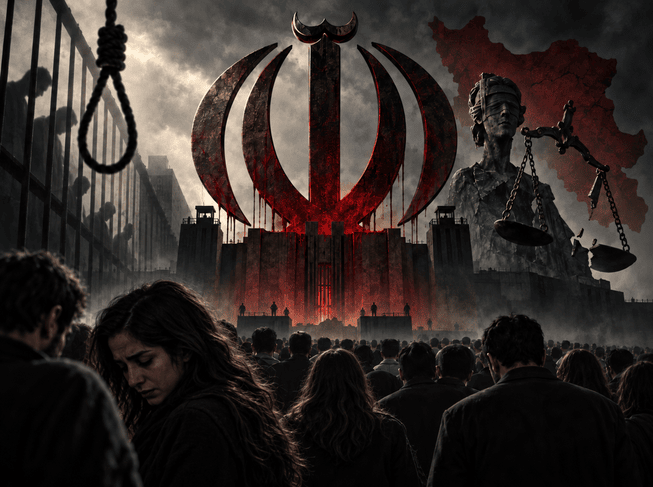
Issuing the death sentence for Najmeh Amini, a 23-year-old woman who was tried on the charge of insulting sacred things in cyberspace, is not only a tragic and isolated news; Rather, it is a telling piece of a bigger puzzle and a naked view of the logic governing the repression machine of the Islamic Republic. With various means, from the streets of Isfahan to the courts of London and from solitary cells to social networks, this machine pursues a central goal: to escalate the cost of any activism, resistance and expression of independent opinion, to drag the society into passivity, self-censorship and general paralysis.
To understand the mechanism of this system, four apparently separate events at the present time must be put together. On the one hand, the revelation of the lawyer of the defendants of "Alikhani Square" in Isfahan that none of the 12 defendants were charged with murder, sheds light on the genealogy of the project of judicial intimidation. By attaching heavy labels such as "murder", before any judicial process, the judicial-security system begins to psychologically label and delegitimize protests. In this structure, the judicial courts are not the arena of proceedings, but the executive arm of intimidation and the machine of creating scary narratives to block the fundamental right to protest.
On the other hand, the report of human rights organizations on the execution of at least 617 people in 9 months reveals the industrial function of this mechanism of physical elimination. Execution in this structure, beyond legal punishment, is the main technology for consolidating power through naked violence and creating collective terror; The governance method of a system that, with the complete loss of the social base, sees its survival solely dependent on depriving the citizens of their right to life.
On a further level, the planning of the security institutions of the Islamic Republic to eliminate and threaten journalists in London shows that this logic of repression has also penetrated geographical borders. This approach reveals the depth of the fragility of governance against the collapse of information monopoly. By accepting high political and diplomatic risks, the regime tries to expand the scope of intimidation beyond the borders; An obvious desperation from a structure that considers any independent voice as an existential threat even thousands of kilometers away from its borders.
Finally, the case of Najmeh Amini is a layering of the most private area of resistance, which is belief and individual expression. Determining the heaviest punishment for an activity in cyberspace is a clear message of the government to impose absolute silence, even in the most private areas of personal life, so that citizens learn that the least expensive way is silence.
The set of these actions reflects the structural image that has entered the final phase of the structural crisis; Armed totalitarianism, which is not able to maintain its domination without relying on the machine of repression and systematic killing. This pattern is not a sign of stability and authority, but a testimony to the complete political and historical impasse of a regime that has defined its existence by declaring an all-out war against society. This relentless resort to intimidation and violence does not stop the crisis, but accelerates the final rupture; A closed cycle that makes the gap between the society and the entire ruling structure unfillable and leads the society to the explosion of accumulated anger and decisive confrontations.


