An Inquiry into the Concept of the Ruination of the Human, and Why the Iranian Human Is the Indestructible One
🖌Rola Zamzameh
Human beings, in the words of Maurice Blanchot, are “the indestructible that can be destroyed forever.” This formulation holds for the Iranian human across five decades of rule under the Islamic Republic: a human being driven from one ruin to another, until finally becoming that which is emptied of ruin itself. Becoming nothing. This “nothing” is precisely what the Islamic Republic has spent five decades constructing: anonymous masses perpetually reconstructed yet always identical, a mass of non-humans marching and working in silence.
Two centuries ago, when Francisco Goya painted one of the most harrowing anti-war images in history, he could not have imagined that three decades later photography would disseminate human suffering on a vast, borderless scale, with what Susan Sontag called “frightful clarity.” The Third of May 1808, in Sontag’s reading, marks a turning point in the history of moral feeling and the history of grief: equally profound, equally creative, equally exhausting.
In Goya’s painting, the cubic lantern illuminating the victims’ faces is itself the camera, recording the human being in ruin and consciously reproducing suffering as a means of “awakening conscience, shocking, and wounding the viewer.” On the left side of the canvas, ordinary people kneel on blood-soaked ground amid the bodies of the executed, facing the firing squad; others appear almost centrally as spectators. At the center stands a man in a white shirt and yellow trousers, arms raised. Between him and the rifle-bearing soldiers, embodiments of human depravity, stands the cubic lantern exposing the victim’s face with “frightful clarity.” That clarity is the very image of ruin repeated throughout history in the form of suffering, whether in the crucifixion of Christ, the burning of Joan of Arc, or the execution of political prisoners in the twentieth and twenty-first centuries.
In The Third of May 1808, Goya accomplishes what, 130 years later, Pablo Picasso would do mercilessly in Guernica. In that painting, another portrait of human ruin, the village of Guernica in northern Spain is bombed by Nazi German aircraft on April 26, 1937. Death, violence, cruelty, anguish, and despair converge in stark black and white, echoing the visual language of newspaper photography, leaving for future generations a testament to the horrific madness of war.
What Picasso’s monochrome palette achieves in Guernica, the cameras of Alexander Gardner during the American Civil War; Felice Beato and Roger Fenton during the Crimean War; Jack Turner in the First World War; and Willi Ruge in the Chaco War achieved. So too did the lenses of Gerda Taro, Joe Rosenthal, and Robert Capa in the Second World War and the Spanish Civil War; of Dickey Chapelle, Larry Burrows, and Eddie Adams in Vietnam; of Werner Bischof and Don McCullin during famine and war in India and Biafra. And now, in the twenty-first century, the cameras of anonymous citizen-journalists transmit yet another image of this indestructible human being to the world, so that death and suffering, alongside human progress, continue to walk hand in hand with the history of photography.
Unlike written reports, calibrated through complexity of thought, reference, and vocabulary for broader or narrower audiences, the photograph speaks a single language, and its potential audience is everyone. For this reason, what Sontag calls the “sting of the photograph” strikes more deeply at “everyone”: the smallest static unit in memory. In an age flooded with information, the photograph provides a swift way of grasping something and a compressed form for remembering it.
The images of justice-seeking families dancing upon the graves of their loved ones constitute an infinite “shot” of the indestructible Iranian human, made emphatically singular by the glimmer of thought visible on their faces (for example, the mother of Sorena Golgoon, Nehayat Rahimi, Nima Parsa, or Ilya, the ten-year-old son of Afsaneh Mehdi-Nejad). In Remnants of Auschwitz, Giorgio Agamben writes that the human is what remains after the destruction of the human, not because there exists some essential humanity that can be annihilated or saved, but because the place of the human is split in two. The human exists in the gap between the living being and the speaking being, between the inhuman and the human.
It is within this very “gap” that the images of justice-seeking families, their mourning songs and mourning dances, represent a concept of the indestructible Iranian human: an indestructibility born from the ashes of a human being who had already given meaning to that mourning dance, Majidreza Rahnavard, the second person executed during the Woman, Life, Freedom movement.
What the machinery of repression inflicted upon Majidreza Rahnavard was a “double suffering of ruin.” First, by breaking his left hand, tattooed with the Lion and Sun, they sought to destroy part of his Iranian human identity. Then, at the hour of execution, by broadcasting an interview in which he rejected adherence to the regime’s official ideology, they sought to push him further toward the non-human deserving death. Just as the Nazis used the term “figures” or “dolls” (corpses) for Jews in order to strip them of humanity and thus authorize their extermination, so too the apparatus of repression employs labels such as “mohareb” (enemy of God), “rioter,” “traitor,” “separatist,” and “terrorist” to cloak its punishments in religious and legal legitimacy.
Yet the images and comportment of Majidreza Rahnavard demonstrated that this human being prepared for death was no thoughtless non-human. On the contrary, it was precisely thought that endowed his death with human meaning, a Nietzschean meaning.
Majidreza Rahnavard embodied Nietzsche’s tightrope walker: one who refuses “false virtue,” walking the rope where one either falls, stands firm, or finds a way beyond. Facing the camera with open eyes, in his Mashhadi accent, he declared he was ready to be executed three times. Before stepping toward the gallows, this time with closed eyes, he asked that people celebrate after his death. Like Nietzsche’s rope-dancer cast down at the dawn of history, he fell, but in falling, he proclaimed the Twilight of the Idols with his final human breath: “Do not pray or recite the Qur’an at my grave.”
It is this dimension of thought that places the mourning songs and dances of justice-seeking families in direct opposition to the regime’s “false virtue” and to what Václav Havel once called “living within the lie”: a system that has long attempted, through institutions such as the Ministry of Education, state broadcasting, the Ministry of Culture and Islamic Guidance, the Islamic Propaganda Organization, seminaries, mosques, and others, to manufacture a singular model of obedience and name it virtue, Muslims who surrender unconditionally to the will of the Supreme Leader, becoming ruin, nothingness, a formless mass devoid of will and awareness.
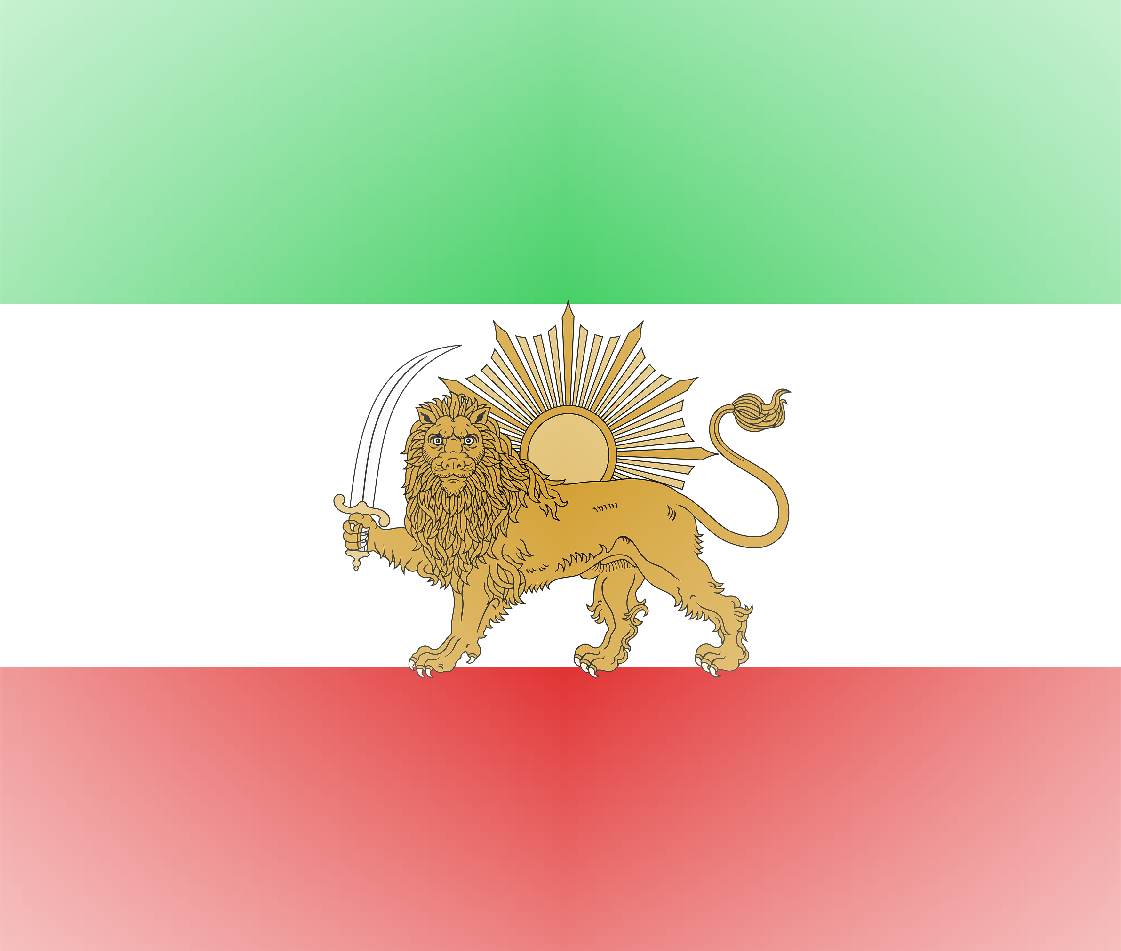
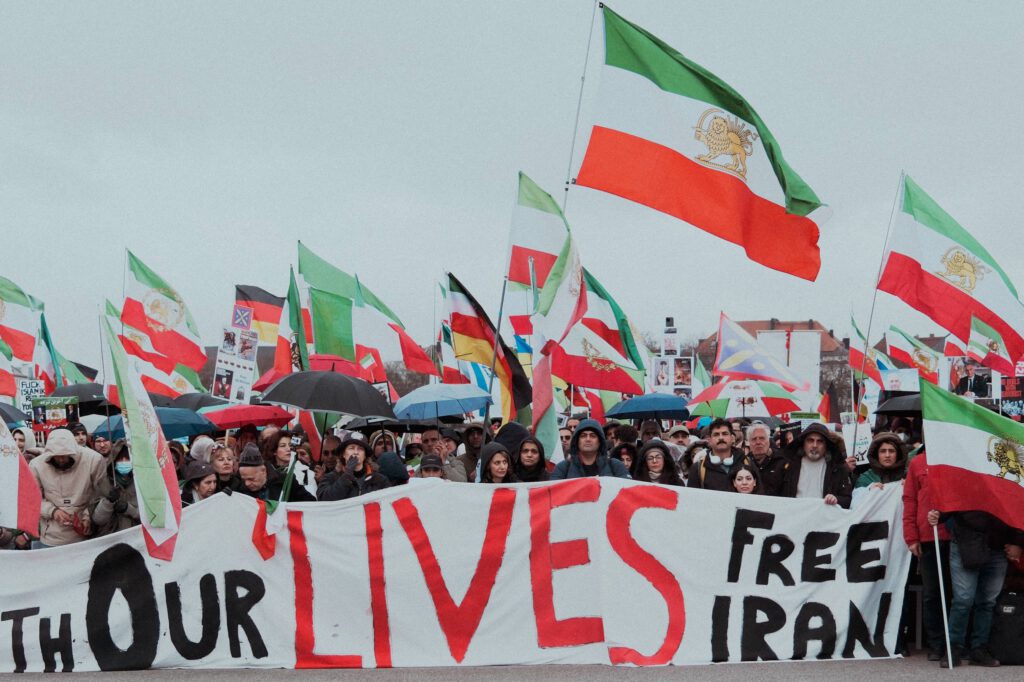
The images of justice-seeking families defy that submission. They seize us, immobilize us with their frightful clarity, clarity that testifies to the doubled suffering of the Iranian human over forty-seven years, and propel us from ruin toward construction in a near future. Especially within the Lion and Sun revival, these families represent an Iranian human struggling for the restoration of dignity. Their mourning dances at gravesites are at once a protest against human suffering and an eternal return to “Iran,” uniting beneath its millennia-old national emblem, the Lion and Sun.
Through song and dance, they declare: we must not place our faith in those who preach otherworldly hopes and sacrifice life for promises beyond this world. When ruling power sanctifies death, returning to national roots and identity-forming institutions becomes the highest form of resistance. No suffering can compel us to testify against life itself. We must call the Iranian human back to life in this world. Together, in this eternal return toward Iranshahr, beyond ideological good and evil, beyond false claims of right and wrong, beyond all that binds us, we must recreate and rebuild each day of this life upon the ruins of religious despotism.
In today’s struggle in Iran, it is no longer the state that determines what the public may or may not see. It is the cameras of mobile phones that disseminate the real images of a different Iranian way of being, documenting truth and justice. These photographs are not aesthetic compositions arranged for future museums, but, as Sontag reminds us, testimony to what remains of injustice. Put differently: “Photographs of suffering and torment do not only recall death, failure, and victimhood; they also keep alive the miracle of survival”, survival for the sake of truth and the realization of justice in a future that is not far away.
*Rola Zamzameh: Senior diplomatic journalist at the European institutions.