
Marjan Abadie
Franco-Iranian psychotherapist and essayist,
We Iranians now wake up with this knowledge: while we were sleeping, several people may
have been executed at dawn.
And with each one of them, it is not only a life that is destroyed. It is part of the promise of
tomorrow’s Iran. Among those who have been killed, imprisoned or sentenced are students,
athletes, artists and workers, but also people who stepped forward to help others, treated the
wounded, or simply refused to look away.
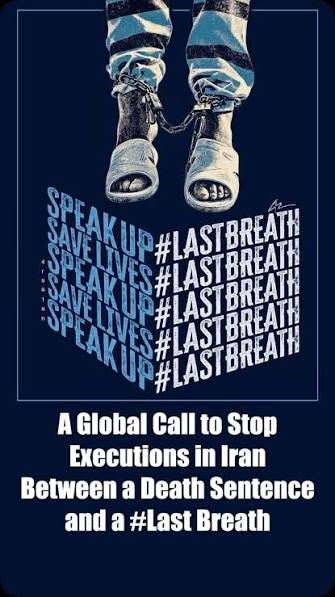
#LastBreath was born in an attempt to stop the next executions: repeat their names, tell their
stories, break the silence before it is too late.
ALMOST ONE EXECUTION EVERY FOUR HOURS
The figures show the scale of the acceleration. According to Iran Human Rights, 267 people
were executed in 2020, 333 in 2021, 582 in 2022, 834 in 2023, 975 in 2024 and at least
1,639 in 2025. In five years, the number of executions documented by the organization
increased more than sixfold.
Amnesty International, which uses a different methodology, puts the 2025 toll even higher: at
least 2,159 executions, the highest number it has recorded in Iran since 1981.
That is 5.9 executions a day. Almost one every four hours.
Another figure is equally striking: according to Iran Human Rights, more than 93% of the
executions recorded in 2025 were not officially announced by the authorities.
Almost one execution every four hours, with more than nine out of ten going unannounced. It
is this machinery of terror and silence that #LastBreath seeks to confront.
WHEN IRAN’S STREETS BREAK THE REGIME’S
OFFICIAL NARRATIVE
Since 1979, Iranians have repeatedly risen up against the Islamic Republic, with the pace
accelerating in recent years: 2019, Woman, Life, Freedom in 2022, then December 2025
and January 2026.
Each time, another battle is also being fought, a battle over the narrative: what do Iranians
actually want, and who represents them?
In late 2025, the death of Khosrow Alikordi, lawyer to Fatemeh Sepehri, triggered a new
wave of anger. Imprisoned for her opposition to the Islamic Republic, Fatemeh Sepehri is an
outspoken supporter of Prince Reza Pahlavi. While some reformist and left-wing currents
portrayed the growing protests as essentially economic, the protesters themselves were
saying something different. In Abdanan, rice was symbolically thrown onto the ground:
they were not in the streets for rice. Their slogans called for the overthrow of the regime,
and one name returned insistently: Reza Pahlavi.
In early January 2026, the Prince called on Iranians to take to the streets en masse on
January 8 and 9. Large demonstrations followed in numerous cities. Videos emerging from
Iran showed crowds demanding the end of the Islamic Republic and frequently chanting
“Pahlavi.”
These images are not an opinion poll. But it would be equally misleading to erase from them
what the demonstrators themselves chose to shout. To those two questions, the streets
were giving an increasingly clear answer: the end of the Islamic Republic, and a name
increasingly prominent in their chants, Reza Pahlavi.
JANUARY 8 AND 9: THE MASSACRE
The regime shut down the Internet. Under this blackout, and with the support of forces
brought in from neighboring countries, a crackdown began whose full scale remains
unknown. Testimonies and images describe the use of military-grade weapons against
largely unarmed crowds, attacks with knives and other bladed weapons, wounded protesters
killed in medical facilities, and healthcare workers tortured or killed for helping them.
Relatives searched for their loved ones among hundreds of body bags as bodies were
transported in large numbers. Some young people were found dead despite having
managed to call their families after being detained. Some families reportedly even had to pay
to recover the bodies of their loved ones, including the cost of the bullets that killed them.
A document presented as originating from Iran’s forensic medicine authorities circulated with
an estimate of as many as 100,000 people killed in two days. The true scale of the
massacre will probably not be known until after the fall of the regime. But the images already
speak for themselves: streets covered in blood and overflowing morgues.
Faced with these images, the Islamic Republic constructed its counter-narrative, attributing
the violence in particular to foreign intervention, especially Israel and Mossad. Turning a
population rising up against its rulers into a foreign threat provides the justification
for violence against it.
AFTER THE BULLETS, THE GALLOWS
The January massacre did not end when the streets emptied. It moved behind prison
walls.
Thousands of young people were arrested. The shootings in the streets were followed by
interrogations, torture, forced confessions, trials and death sentences for “enmity against
God.”
Amnesty International has documented how, since Woman, Life, Freedom, the Iranian
authorities have increasingly used the death penalty as an instrument of terror and
repression.
In the streets, there were thousands of witnesses and phones recording what happened.
Behind prison walls, a condemned prisoner can be hanged at dawn, almost without images
and without witnesses.
That is where #LastBreath begins.
THEY HAVE A NAME. AND A FUTURE.
Around the world, influencers, public figures, activists and ordinary citizens are rallying
around this hashtag to make known the names of those sentenced to death or at risk of
execution.
Because behind the numbers are individuals. Students, athletes, workers, artists, fathers
and mothers. Some helped wounded protesters or came to the aid of others. Some did
nothing more than exercise what we consider here to be a fundamental right: to protest.
Above all, they have a future.
They are also the doctors, athletes, artists, entrepreneurs and engaged citizens that
tomorrow’s Iran will need. By executing them, the Islamic Republic is not only destroying
lives. It is also striking at those who could rebuild the country after it is gone.
Making their names known alerts journalists, NGOs, elected representatives and
governments, which too often remain silent through lack of awareness, but also because the
Islamic Republic has spent decades constructing counter-narratives capable of relativizing or
concealing the nature of its repression.
CAN A HASHTAG SAVE A LIFE?
For those who experienced the pain of October 7, for those who waited for a hostage to
return, displayed their face or repeated their name so they would not be forgotten,
#LastBreath carries a particular resonance.
The Islamic Republic has long understood the power of this form of violence. Since the
seizure of the US Embassy and its hostages in 1979, it has repeatedly used the detention of
foreign and dual nationals as an instrument of pressure in its relations with democracies.
But there is another hostage, far larger and too often forgotten: the Iranian people
themselves. For forty-seven years, millions of Iranians have lived under a regime they did
not freely choose, a regime that imprisons, tortures and executes those who challenge it and
responds to demands for change with repression.
This is not about comparing histories or suffering. But those who have known the anguish of
waiting for a hostage understand why a name and a face matter. To name someone is to
refuse to let a human being disappear behind a number.
That is exactly what we are doing with #LastBreath: behind every number, showing a face,
telling a story and defending a life, acting while there is still time.
Not so that we can remember them tomorrow. So that they will still be here tomorrow.
#LastBreath


